The direct answer is yes. In 2026, a non-technical person can build a genuinely functional full-stack app without hiring a developer or writing code. Not a prototype that breaks when real users arrive. Not a frontend with mock data wired behind it. A working application: real database, real authentication, real API layer, deployed to production. The capability that made this possible arrived in 2025, and it is not incremental. Certain platforms now generate actual backend infrastructure from a natural-language prompt. Understanding what specifically changed matters more than knowing it happened.
What "full-stack" actually means for a non-technical founder
"Full-stack" is the kind of term developers use, and founders nod at without always knowing what it covers. The definition has real consequences for how you evaluate any tool you're considering.
A full-stack application has three distinct layers. The frontend is what users see and interact with. The backend is the server logic that processes requests, enforces rules, and talks to the database. The database is where data lives permanently between sessions. A real full-stack app needs all three to be real.
The confusion most non-technical founders run into is this: many tools generate the frontend and simulate the backend. What you get looks like an application in every screenshot and demo. Then, a hundred users sign up on launch day; their data needs to persist somewhere real. Two users try to access the same resource at the same time, and things break.
If you're building anything where users have accounts, store data, pay for something, or interact with each other, you need a real backend and a real database. Not a simulation. The actual thing.
That's what "full-stack" means for your purposes, and it's the most useful thing to verify about any tool you use.
What was true in 2022 that isn't true anymore
Three years ago, if you were a non-technical founder trying to build your own product, your options were roughly as follows: hire a developer, learn to code, or use a no-code tool and accept its limitations.
The no-code tools of 2021 and 2022 were genuinely useful for certain things. Landing pages, simple forms, basic automations. But anything requiring a real backend (user authentication, relational databases, conditional logic at real complexity) either needed significant configuration or wasn't possible without custom code. The ceiling was real, and you hit it fast.
I can tell you exactly when I hit it. I built a prototype for a B2B tool in late 2022, spec'd carefully in a Google Sheets doc with colour-coded feature tiers and everything. The prototype looked right until I needed proper authentication logic with role-based access. The no-code platform I was using could do a simplified version. What I actually needed required a workaround on top of a workaround. By the end, I had something that worked on paper but was too nervous to show to real users. I shelved it.
What changed in 2025 is not that no-code tools got better. A different category of tool emerged: AI app builders that generate real backend code from natural-language prompts. Not configuration. Not visual assembly. Actual code running on real infrastructure. The tools available in 2026 are not the same category of thing as the no-code tools of 2021, and treating them as equivalent will cost you months.
The capability gap that still exists (and what it actually affects)
Content about AI app builders tends toward two unhelpful extremes: either pretending the ceiling doesn't exist, or inventing a scary version of it to make you feel like you need a full engineering team regardless.
The ceiling is real. It's just not where most people think it is.
Non-technical builders in 2026 can handle: standard user authentication flows, relational database design for most product use cases, REST APIs, third-party integrations with well-documented services (Stripe, Mailchimp, Twilio, Slack), and deployment to production infrastructure. This covers a wide range of products: internal tools, SaaS dashboards, marketplaces at an early scale, and customer-facing portals.
Where you will hit a ceiling: genuinely custom integrations where the third-party API is poorly documented or requires unusual authorisation flows. Complex business logic with deeply nested conditionals and many edge cases. Enterprise compliance requirements at the depth a large procurement team requires. Custom infrastructure decisions that need architectural judgment.
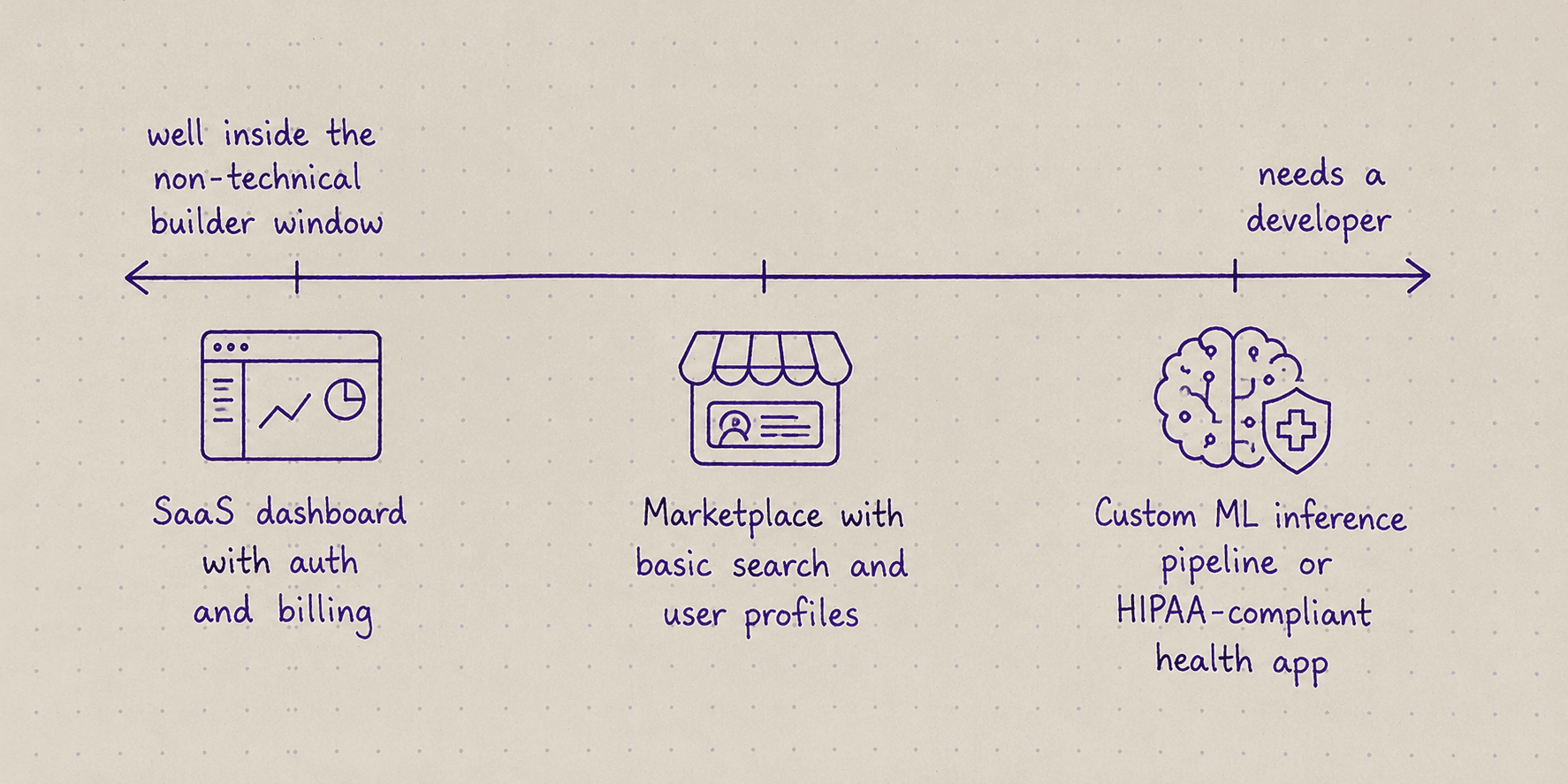
None of this disqualifies you from building. It means you need to know where your product sits before you start. If your MVP is a tool where users log in, view or submit data, and pay you, you're well inside the window. If your MVP requires enterprise compliance from day one, you probably need technical help regardless of which tool you use.
Knowing where the ceiling is matters more than pretending it doesn't exist.
What a non-technical person can realistically build today
After shelving that prototype in 2022, I spent ₹12,000 on a developer on Fiverr in early 2023. He delivered a Figma mockup, took a partial advance, and disappeared. I'm not that bitter about it now. What that experience actually taught me is something I should have known already: I was paying for construction when I had no proof the thing was worth building. The lesson is about validation sequencing (sorry, that's MBA-speak for "test before you build"), not about developer reliability.
That reframing changed how I viewed AI app builders when the category fully emerged in 2024. I wasn't looking for something that could replace a full engineering team. I was looking for something that could get me to a working product fast enough to show real users, collect real signal, and decide whether to invest further.
What Mayson generates from a single prompt is the full stack: database, backend logic, API layer, frontend, and deployment configuration. That's the specific difference that made this feel unlike everything I'd tried before. If you want to see what other builders have shipped on the platform, see what others have built on Mayson
The benchmark I'd suggest for evaluating any tool you're considering: can it tell you specifically what database it uses, what your authentication flow looks like, and what happens to your code if you move off the platform? If the answers are vague, the backend probably isn't real. Mayson offers a free tier with 10 credits and no credit card required. Try that test yourself
Where AI app builders still need a human in the loop
Even when the backend is real and the generation is solid, there are decisions you still need to make yourself. The AI doesn't know your users. It doesn't know which feature matters more to them. It doesn't know whether the authentication flow that works for a consumer app is the right one for a B2B product in which companies pay per seat.
The human-in-the-loop moments I've run into most:
Scoping the prompt. What you ask for determines what you get. Vague prompts produce generic structures. "Build me a CRM" produces something technically functional and probably not what you need. "Build me a tool where a salesperson can log a call outcome against a contact, see the full interaction history, and flag a contact for follow-up in three days" produces something you can actually use. The specificity is the job. This is where domain knowledge does more work than any technical skill.
Reviewing what was generated. You should be able to read through the database structure and the main API endpoints your tool produces and check them against your mental model of how the product should work. You don't need to understand every line of code. You do need to understand the shape of the data: what gets stored, what gets retrieved, and what connects to what. This is learnable in an afternoon and worth doing before you show anyone.
Iteration decisions. The first version the AI generates is rarely the final version. What to prioritise next, what to leave out, when the product is good enough to ship: these are judgment calls. My MBA operations professor, Dr Wendy Alderton, had a line that comes back to me often: "Strategy without execution is hallucination." The reverse is also true. The AI handles the execution. The judgment is yours.
How to tell if what you built is real enough to charge for
This question comes up more than almost any other among founders who've just shipped their first AI-generated product. The bar isn't technical. It's functional.
Ask yourself four questions.
Can users sign up, log back in and see their own data, not someone else's? If yes, authentication is working, and data is correctly isolated.
If a user pays and then closes their browser and comes back tomorrow, is their purchase status still there? If yes, your database is persisting state correctly.
If two users sign up at the same time, does the application handle both without corrupting either account? If yes, your backend handles basic concurrency.
If you turn off your laptop right now, is the app still running for your users? If yes, you're deployed to actual infrastructure, not just running locally.
Four yeses means you have something real. You need a browser, two email addresses, and twenty minutes to find out.
Charging adds one further threshold: your Stripe integration should be in live mode, not test mode, and your terms of service should state at a basic level what you do with user data. But the technical bar for "is this real" is those four questions. Most founders I talk to who are anxious about charging have long passed the technical threshold long before they feel emotionally ready.
The honest answer to "but will I need to rebuild it later?"
This anxiety sits underneath almost every conversation about non-technical building, and it deserves a direct answer rather than reassurance.
The honest version: maybe, eventually, if your product succeeds past a certain scale. But probably not for the reason you're worried about.
Most products built by non-technical founders don't fail because the backend couldn't scale. They fail because the product didn't find users, or the founder ran out of momentum before distribution. The "rebuild when you grow" problem is real but second-order. The first-order problem is getting to a point where growth is something you actually have.
The more useful question is whether you own the code. If you build on a platform that generates real code and gives you the repository, you're not locked in. A developer can take what was built and extend it later. The rebuild-from-scratch scenario only happens when you're inside a platform's proprietary system with no exit route: the app only runs on their servers, and if you leave, you start from zero.
This is why "Do you own the code?" is the most useful question to ask before picking a tool. Not the number of templates. Not which AI model it runs on. Whether the output is code you own or a configuration that lives exclusively on their servers.
I keep a Notion database of ideas I'll probably never build (47 entries at last count). The ones I'm actually evaluating now are the ones where I can answer the code-ownership question cleanly before I start. That filter alone has saved me from at least two more false starts in the past year.
FAQ
Do I need to learn to code to use an AI app builder?
What's the difference between a no-code tool and an AI app builder?
Can I build a SaaS product without a technical co-founder in 2026?
What happens if I need a feature the AI builder can't generate?
Will investors take a product built with an AI app builder seriously?
How do I know if my app is actually full-stack or just a frontend?
Abhishek is a strategy consultant and non-technical founder who shipped his first SaaS product over a weekend in 2025, after a long false start. He still consults during the week. He writes about the practical mechanics of building without a technical co-founder.
Featured Blogs

Can a non-technical person build a full-stack app in 2026?

What is backend infrastructure, in plain English?

Building an MVP in India on a tight budget: what actually works
More Article by Mayson
How Parallel Building Lets Solo Developers Ship Like a Team of Five
Why Indie Devs Can't Ship Fast (And How to Eliminate Boilerplate for Good)